Your first year in test and tag: a business plan and 12-month checklist
A test and tag business plan for your first year: a one-page plan, break-even number, a month-by-month checklist, fixed tax dates and five numbers to track.
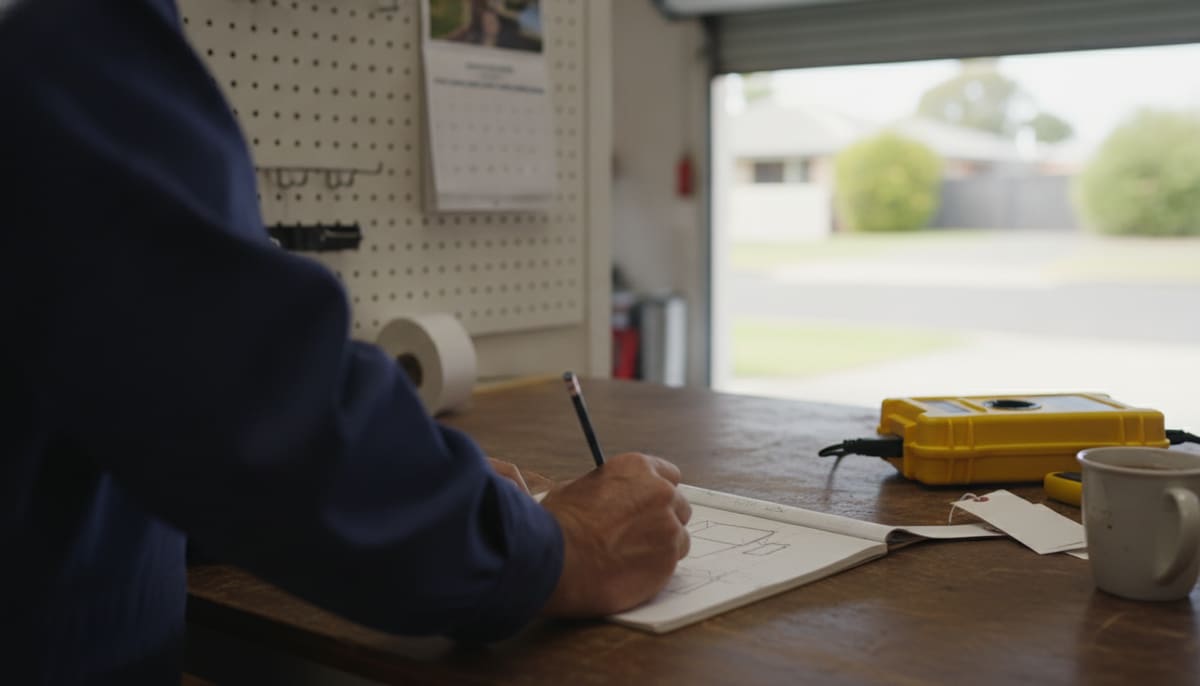
A test and tag business plan for your first year doesn't need to be a 30-page document. It needs to answer five questions on one page: who you'll sell to, what you'll charge, how many items you need to test to break even, where your first clients will come from, and what could go wrong. Then it needs a 12-month calendar with the fixed dates you can't miss, such as BAS, insurance renewal, tester calibration and your first retests, plus a handful of numbers you check every month.
This guide gives you both. It assumes you've already worked through the setup steps (training, licence check, ABN, insurance, tester) in our guide to starting a test and tag business. This is what comes next: planning the year so the business is still there at the end of it.
General information only, not legal, tax or financial advice. Tax dates and thresholds change, so check them with the ATO and your accountant or registered tax agent, and check licensing with your state's electrical safety regulator.
Why a plan matters more in test and tag than in most trades
Test and tag is repeat work. An office you test in March is due again in a year or more, depending on its risk. A building site you test this month is due again in about three months under AS/NZS 3012 (see the test and tag frequency guide for intervals). So your first year is unusual: you're winning every client from scratch, and the rebookings that make the business easier only start arriving towards the end of it.
That means two things for your plan:
- Year one is the hardest year for cash. You pay for the tester, insurance and setup up front, and most of your income comes from new clients, which take the most effort to win.
- Every client you win in year one is an asset for year two, but only if you record their due dates and rebook them. A plan that ignores rebooking is a plan to start from zero every January.
The one-page plan
The business.gov.au business plan page has a free online tool for a simple plan and a detailed template if you're seeking finance. Either works. For a solo test and tag business, these seven headings cover what matters:
| Section | What to write | Example answer |
|---|---|---|
| Who you serve | The 2 or 3 types of client you'll target first | Offices, schools and small builders within 40 km |
| What you sell | Your services, and what you don't do | Test and tag, RCD testing; repairs referred to an electrician |
| Prices | Per-item rate, minimum charge, extras | Your own figures from your cost floor |
| Break-even | Items a year you must test to cover costs and pay yourself | See the next section |
| Finding clients | The 3 channels you'll actually work every week | Network, electricians, Google Business Profile |
| Costs and cash | Startup costs, yearly running costs, how you'll cover the slow months | Savings buffer, short payment terms |
| Risks | What could stop you working or getting paid | Tester away for calibration, one large slow payer |
Keep it to a page. You'll come back to it every quarter, and a page is something you'll actually reread.
Work out your break-even number first
Your break-even number is the one figure that turns the plan from a wish list into a target. You need three inputs:
- Your yearly costs: insurance, any licence fees, software, tags, vehicle, phone, calibration, accounting, and the tester's cost spread over its life.
- What you need to pay yourself for the year.
- Your price per item, after your minimum charges and extras even out.
Then divide costs plus pay by your average income per item.
Worked example (illustrative numbers only). Suppose your yearly costs are $18,000 and you want to pay yourself $55,000, so you need $73,000. If your work averages out at $5.50 an item, you need about 13,300 items in the year. Over 46 working weeks, that's about 290 items a week.
Now test that number against reality. How many items can you test in a day once you count travel, set-up and writing up? Our guide on how long test and tag takes per item walks through that. If the weekly target needs more testing days than you have, the plan has to change: raise your prices, lift your minimum charge, cut costs or target larger sites. Our guide to pricing test and tag work covers how to set each of those.
The 12-month checklist
Before your first job
The setup steps live in our starting guide. As a quick check before you book anyone:
- Training done and certificate on file.
- Your state's licence rules checked for the business, not just the tester. In Queensland, for example, a test and tag business needs an electrical contractor licence that covers the work.
- ABN, business name and a separate bank account.
- Insurance in place and a certificate of currency ready to send.
- Tester bought, with its serial number and calibration due date written down.
- Price list, quote template and invoice template ready.
- A register set up for clients, sites, items, results and next due dates.
Months 1 to 3: first clients and good habits
- Work your three channels every week, even when you're busy. Our guide to finding test and tag clients covers where first clients usually come from.
- Record every item properly from job one: an asset ID that matches the tag, location, class, readings, result and next due date.
- Invoice before you leave the site and keep payment terms short.
- Book a weekly admin hour for invoices, follow-ups and your register. It's easier than a monthly catch-up.
- Ask every happy client for a review and a referral.
Months 4 to 6: first review
- Check your actual numbers against the plan: items tested, average job value, and how many days you really worked.
- Check your prices. If small jobs are losing money once you count the drive, raise your minimum charge now rather than in a year.
- Lodge your first BAS if you're registered for GST (see the dates below).
- Look 90 days ahead at what's coming due. Construction and hire clients tested in your first month will already be due again.
Months 7 to 9: build the rebooking engine
- Contact clients a few weeks before their retest is due, and book the next visit before you leave each site. Our guide to retest reminders across many clients covers how to run this.
- Group visits by area and month so you're not driving across town for one small job.
- Decide what you'll do with spare capacity. If the diary has gaps, it's time for a new channel or a new sector, such as schools, construction or hire.
Months 10 to 12: your first anniversary
- Your first 12-month retests start coming back. This is the month the business either gets easier or doesn't. Every client you rebook here is work you didn't have to win.
- Renew insurance and check the covers still match what your clients ask for.
- Book the tester's calibration around your quietest weeks. Follow your manufacturer's recommendation. Many recommend yearly calibration. Plan for the days it's away, or arrange a second tester.
- Review the year against your one-page plan and write next year's.
Fixed dates to put in your calendar now
Put these in your calendar on day one, with a reminder two weeks before each.
| What | When | Notes |
|---|---|---|
| Quarterly BAS (if registered for GST) | 28 October, 28 February, 28 April, 28 July | For the July–September, October–December, January–March and April–June quarters. Lodging online or through an agent may give you more time (ATO) |
| Individual tax return (sole trader lodging yourself) | 31 October | A registered tax agent may be able to lodge later (ATO) |
| PAYG instalments | Usually quarterly, once you're in the system | See the next section |
| Insurance renewal | 12 months from your start date | Clients may ask for an updated certificate of currency |
| Tester calibration | Per your manufacturer | Keep the certificate with your records |
| First retests | 3 months (construction, hire) to 12 months and beyond | Driven by your register's next due dates |
If a BAS due date falls on a weekend or public holiday, the ATO gives you until the next business day.
Plan for tax before the bill arrives
Many new sole traders get caught by their first tax bill, because nothing was taken out of their income during the year. Two things help:
- PAYG instalments. As a sole trader, the ATO says you'll be entered into PAYG instalments automatically once your latest tax return shows instalment income of $4,000 or more, tax payable of $1,000 or more and estimated tax of $500 or more. If you're new to business and expect to pass the threshold, the ATO suggests you can enter voluntarily, so you pay during the year instead of in one hit (ATO).
- A separate tax account. Move a set share of every payment into it on the day it lands, covering GST collected and income tax. Ask your accountant what share suits your situation.
Also keep your business records for five years. The ATO says that's the general rule for most business records, with some kept longer (ATO). Your test records have their own rules. See our guide to what test and tag records to keep.
Five numbers to check every month
You don't need a dashboard of 20 metrics. These five tell you whether the plan is working:
- Items tested this month, against your break-even target.
- Average job value. If it's falling, small jobs are taking over the diary.
- Rebooking rate: of the clients who fell due this month, how many booked again.
- Money owed over 30 days, in dollars and by client.
- Items due in the next 90 days. This is your future work, already in the register.
Write them down on the first working day of each month, in the same place. After six months you'll see trends no single month shows.
Risks to plan for in year one
- The tester is your business. If it's damaged, stolen or away for calibration, you can't work. Know what cover you have and how long a replacement or loan unit takes.
- One client is too much of your income. If a single client is a large share of your work, losing them hurts. Keep winning smaller clients while you serve the big one.
- Slow payers. A large client on 60-day terms can leave you short even when you're busy. Agree terms before you start, and invoice on the day.
- You get sick or injured. As a sole trader there's no workers' compensation for you. Talk to a broker about personal accident or income protection cover.
- Working outside your competence or licence. Construction, mining and three-phase work can bring extra requirements. Check before you quote.
Reviewing the plan at the end of year one
At month 12, sit down with your one-page plan and the monthly numbers and ask:
- Did you hit your break-even number? If not, was it price, volume or costs?
- Which channel brought the best clients, not just the most?
- How many year-one clients have rebooked or are booked?
- What took the most admin time, and can a tool or a process take it off your hands?
- Is it time to hire? Our guide to hiring your first test and tag technician covers the signs.
Then write next year's page. Year two starts with a register full of due dates, which is the point of doing year one properly.
Running year one in Koalaris
Most of the checklist above depends on a register you can trust: next due dates per item, a 90-day look-ahead, and invoices that go out before you leave the site. That's what Koalaris, our test and tag app, is built for. The Free plan has an offline field app, instant tag printing, PDF certificates with your logo and a free client portal, with no card needed, no time limit and no record limit. When you're ready to invoice from the finished visit, take card payments on site by QR code and sync to Xero, the Solo plan is $29 a month. See plans and pricing for the details.
Frequently asked questions
Do I need a business plan to start a test and tag business?
There's no legal requirement to have one. A lender will usually ask for one if you're seeking finance. Even if you're not, a one-page plan with your break-even number and a 12-month calendar helps you price properly and spot problems early. The business.gov.au tool and template are free.
How many clients do I need in my first year?
It depends on your break-even number, not a client count. Work out how many items a year you need to test to cover your costs and pay yourself, then how many items your typical client has. A few large sites can do the work of dozens of small offices, but they also carry more risk if you lose one.
When do retests start coming back?
It depends on your clients. Construction and hire equipment is commonly retested every three months, so those clients come back within your first quarter. Offices and similar low-risk sites are usually on 12-month or longer intervals, so their first retests arrive near your first anniversary. Your register's next due dates tell you exactly when.
What tax dates should a new test and tag business know?
If you're registered for GST and report quarterly, BAS is due on 28 October, 28 February, 28 April and 28 July. Sole traders who lodge their own tax return have until 31 October. A registered tax agent may be able to lodge later. Check your dates with the ATO or your agent, because they depend on your situation.
What should I review at the end of my first year?
Compare your actual items, average job value, rebooking rate and money owed against your plan. Look at which channels brought your best clients and what took the most admin time. Then write next year's plan, starting from the retests already in your register.

Koalaris is test and tag software built in Australia. See what it does.
Keep reading
 Guides
Test and tag for events and markets: a guide for operators
Test and tag for events and markets: what organisers and councils ask stallholders for, AS/NZS 3002, leads and RCDs, and how operators run event-day testing.
 How-to
Test and tag register template (free CSV) and how to fill it in
Download a free test and tag register template in CSV. What each column means, the extra columns worth adding, and how to stop Excel breaking your tag numbers.
 Guides
Changing test and tag software without losing your history
Changing test and tag software? When to switch in the retest cycle, how to keep your tags, asset numbers and old certificates, and what to tell your clients.
See your register the way Lyra sees it.
Start free, for as long as you like. No card needed.