Test and tag for events and markets: a guide for operators
Test and tag for events and markets: what organisers and councils ask stallholders for, AS/NZS 3002, leads and RCDs, and how operators run event-day testing.
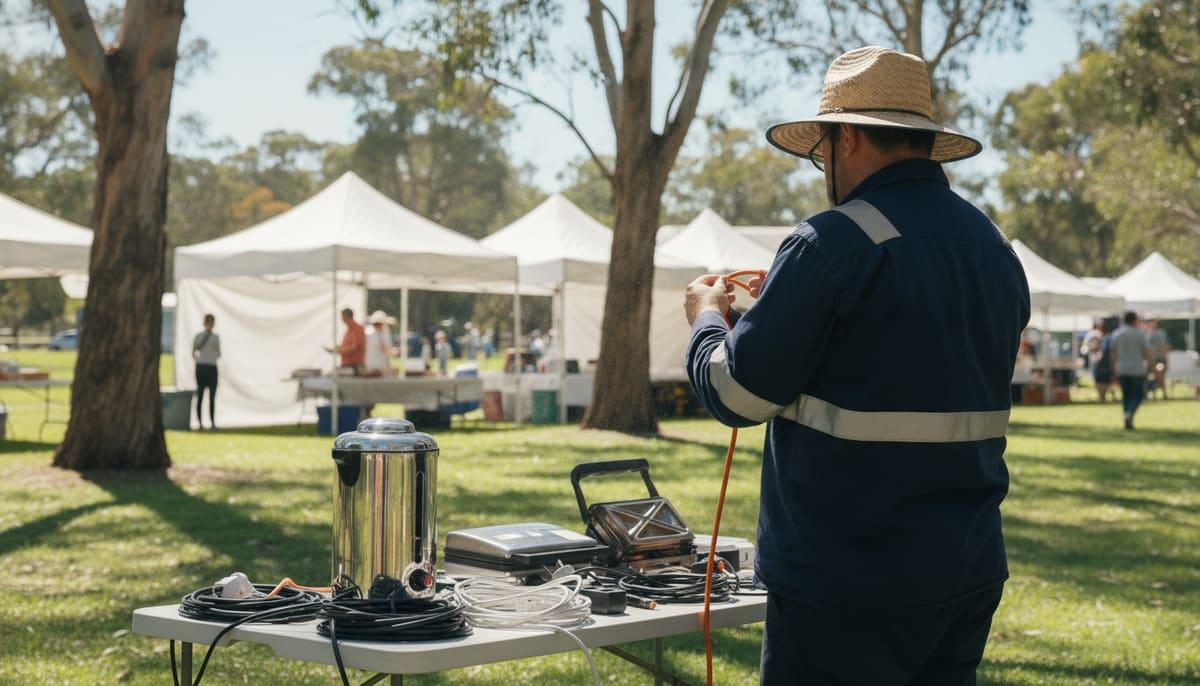
Test and tag for events and markets is mostly driven by the organiser, not a single national rule. Councils and market operators usually write it into their stallholder terms: every lead and appliance must carry a current test tag, and power leads must be tested and tagged by a competent person or an electrician. Behind those terms sit the same in-service testing standard used in workplaces, AS/NZS 3760, plus a standard written for events, AS/NZS 3002.
This guide is for test and tag operators who want to sell into events, markets, shows and festivals. It covers what organisers actually ask for, where AS/NZS 3002 fits, the gear you'll see, and how to run a stallholder testing day without losing your records.
General information only, not legal advice. Requirements differ between states, councils and events. Check the current editions of AS/NZS 3760 and AS/NZS 3002, the relevant state regulator, and each event's own terms.
What organisers and councils ask for
Event requirements usually reach a stallholder through a council permit, a venue hire agreement or the market's terms and conditions. A few published examples show the pattern:
| Source | What it asks for |
|---|---|
| Cairns Regional Council markets (Qld) | "All electrical equipment leads and appliances must display a current electrical certified test and tag sticker" (Cairns Markets terms and conditions) |
| Redland City Council events (Qld) | All electrical equipment, including extension leads, tagged and tested in line with AS/NZS 3760, extension leads tagged with the owner's name, and portable RCDs as an extra precaution (Redland City Council) |
| City of Boroondara outdoor events (Vic) | All power leads tested and tagged by a certified test and tagger and/or an electrician. Generators, distribution boards and temporary cabling done and signed off by a licensed electrician (City of Boroondara) |
| SafeWork NSW, amusement devices at shows | Testing and tagging, including RCDs, by a competent person at least every 12 months. Organisers should ask suppliers for a register showing testing in the past 12 months (SafeWork NSW) |
| WA Health, public buildings | Electrical leads and RCDs tested and tagged every 12 months, leads in accordance with AS/NZS 3760, under the Health (Public Buildings) Regulations 1992 (WA Health) |
Three things stand out:
- The sticker is the proof most organisers check. A market manager walking the rows looks for a current tag on every lead and appliance. That puts weight on a tag that's readable and dated, which should show who did the test, the test date and the retest date.
- Bigger events ask for a register. NSW guidance for show organisers talks about a register of equipment with testing records, not just tags. Ride and amusement operators, caterers with commercial gear and production companies will expect you to supply one.
- Interval rules vary. Some events set their own cycle in their terms, and regulators publish intervals by environment. Don't assume one number fits every event. Our test and tag frequency guide explains how the AS/NZS 3760 intervals work.
Where AS/NZS 3002 fits
AS/NZS 3002:2021 is titled Electrical installations – Shows, carnivals and events. It sets requirements for supplying electricity to equipment at shows, carnivals and public events, and it also makes recommendations for the in-service testing of portable and fixed electrical equipment used on those sites (Building CodeHub). Where it doesn't specify a requirement, AS/NZS 3000 applies.
In practice, the split looks like this:
- The event's supply and temporary wiring (generators, distribution boards, temporary cabling, connection to mains) is electrical work for a licensed electrician. South Australia's guidance for festivals and public events names AS/NZS 3002 and says only licensed electricians can do electrical work in SA (SA Government). WA Health also points generators to AS/NZS 3010.1.
- The plug-in gear on the stalls (leads, power boards, appliances, lights, portable RCDs) is where test and tag operators come in, using the AS/NZS 3760 inspection and test methods.
If you hold only a test and tag competency, stay on the plug-in side of that line. The ACT regulator, for example, names AS/NZS 3002 alongside AS/NZS 3760; our test and tag requirements by state hub links to each regulator. Buy the current edition of AS/NZS 3002 from Standards Australia if you plan to work events regularly, so you can read its testing recommendations for yourself.
What gear you'll test at markets and events
Stallholder gear is different from office equipment. Expect a lot of it to be used outdoors, packed into a car every weekend and plugged together in ways the maker never planned.
- Extension leads and power boards. The most common item, and the one organisers check first. Boroondara's guide calls out leads by name, and Redland asks for leads tagged with the owner's name so mixed-up leads can be returned.
- Cooking and heating appliances. Urns, sandwich presses, hotplates, fryers, coffee machines and bain-maries from food stalls. These are often Class I (earthed) and see heavy use.
- Lighting. Festoon lights, LED floods and lamps for night markets.
- Portable RCDs. Redland recommends plugging portable safety switches in as an extra precaution, and SafeWork NSW includes RCDs in the testing for amusement devices. Test them as well as the gear plugged into them.
- Small motors. Fans, juicers, blenders and pumps.
Common fails at a market stall are the ones a careful visual inspection finds: crushed or cut leads from car doors and gazebo legs, cracked plugs, taped repairs, and cords pulled out of their anchorage.
How to run a stallholder testing day
Many operators offer a "bring your gear" session before a market season or a big event. It's high volume and low cost per item, and it's a good way to meet stallholders who also run businesses during the week. This is a routine that works. Treat it as common practice, not a requirement.
Before the day
- Agree with the organiser who pays: the event, or each stallholder. Most market sessions are pay-per-item at the table.
- Ask the organiser to tell stallholders what to bring: every lead, board, appliance and light they plan to use, cleaned and unpacked.
- Set up a client for each stallholder in advance if you can, from the organiser's stallholder list, so testing starts straight away.
On the day
- Book each stallholder in as their own client, with the event as the site. That keeps their records separate when they ask for a certificate later.
- Inspect, test and tag each item, and record the result against the stallholder, not just "Market day".
- Failed items get a "do not use" tag and go back to the owner with a clear note. Don't repair on the spot unless your licence covers it.
- Hand over or email a certificate before they leave, so they can attach it to their stallholder application.
After the day
- Send the organiser a summary of which stallholders were tested, if the stallholders agree.
- Set retest reminders for every stallholder, so next season's session books itself.
Pricing is usually per item with a minimum per stallholder. Hourly or day rates suit larger events where the item count is unknown.
Winning event and market work
Event work tends to come through a small number of people: council events teams, market managers, show societies and production companies. A few approaches suit them:
- Start with the markets near you. Ask the market manager if they'd like a testing session before the season opens. They get compliant stalls, you get a room full of small business owners.
- Offer organisers a register. For a show or festival, a single register covering every supplier's gear, with current results, answers the question regulators and insurers ask.
- Follow the build crew. Where an event build counts as a construction site, AS/NZS 3012 rules may apply to the tools and leads used to set it up. Our guide to test and tag on construction sites covers those.
For more on building a client list, see how to find your first test and tag clients.
Keeping event records in Koalaris
Koalaris keeps an equipment register for every client and site, records tests in a field app that works offline (useful in a park with patchy reception), prints test tags on the spot and produces PDF certificates with your logo. Each stallholder can be their own client, and their certificates and retest reminders follow them from one market to the next. Every business can start on the Free plan, with no card and no end date. See how it works on the Koalaris test and tag app page.
Frequently asked questions
Do market stallholders need to test and tag their equipment?
In most cases, yes, because the market's terms require it. Councils such as Cairns and Redland in Queensland, and Boroondara in Victoria, ask for every lead and appliance to carry a current test tag. Check each market's terms, since the details differ.
Who can test and tag equipment for an event?
Plug-in equipment can be tested and tagged by a competent person, such as someone trained in AS/NZS 3760 testing, or an electrician. Event power supply, generators and temporary wiring are electrical work and need a licensed electrician.
What is AS/NZS 3002?
AS/NZS 3002:2021, Electrical installations – Shows, carnivals and events, sets requirements for electricity supply at shows, carnivals and public events. It also makes recommendations for the in-service testing of equipment used on those sites.
How often does event equipment need to be tested?
It depends on the state, the type of equipment and the event's own terms. SafeWork NSW guidance for amusement devices says at least every 12 months, and WA Health says leads and RCDs in public buildings every 12 months. Some markets set their own cycle in their terms.
Do new extension leads need testing before a market?
WA Health accepts a date of purchase tag in lieu of testing for new extension cords in public buildings. Elsewhere, check the event's terms: many organisers simply want every lead to carry a current tag.

Koalaris is test and tag software built in Australia. See what it does.
Keep reading
 How-to
Test and tag register template (free CSV) and how to fill it in
Download a free test and tag register template in CSV. What each column means, the extra columns worth adding, and how to stop Excel breaking your tag numbers.
 Guides
Changing test and tag software without losing your history
Changing test and tag software? When to switch in the retest cycle, how to keep your tags, asset numbers and old certificates, and what to tell your clients.
 How-to
How to export results from your PAT tester: Megger, Fluke, Kewtech, Seaward and Metrel
Export test results from Megger, Fluke, Kewtech, Seaward and Metrel PAT testers and their software into a spreadsheet, then import them without retyping.
See your register the way Lyra sees it.
Start free, for as long as you like. No card needed.