Test and tag on construction sites: AS/NZS 3012 requirements
Construction site test and tag requirements under AS/NZS 3012: 3-monthly retests, RCD checks, site tags, records, and how operators quote and run site work.
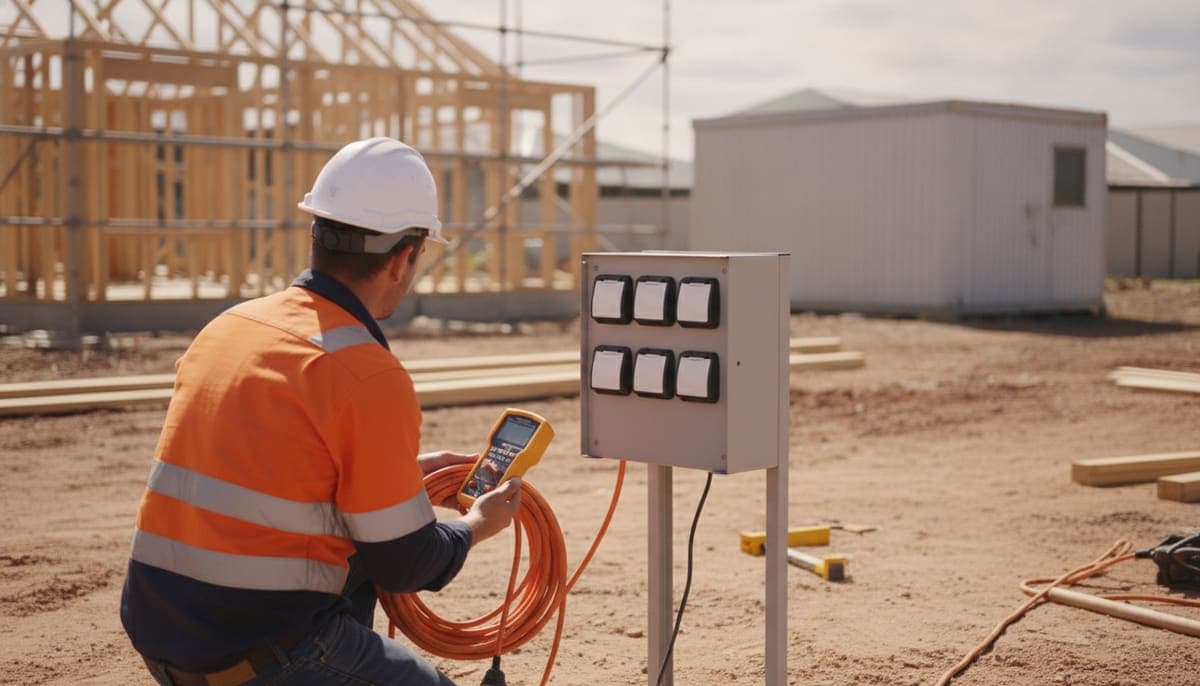
Construction site test and tag requirements come from AS/NZS 3012, not just AS/NZS 3760. On construction and demolition sites, portable tools, leads and power boards are inspected, tested and tagged before first use and then every 3 months. Site sheds, fixed equipment and construction wiring are checked every 6 months. RCDs get daily or monthly push-button tests and a trip-time test every 3 or 12 months. Every item gets a durable site tag, and the records have to be ready for audit.
This guide is for test and tag operators who are quoting or running construction work, and for builders who manage their own site testing. It covers where the rules come from, the intervals regulators publish, what goes on a site tag, which records to keep, and how to run a site so the three-monthly cycle doesn't slip.
General information only, not legal advice. AS/NZS 3012 is a paid standard, and some regulator pages still quote the 2010 edition. Check the current edition, your state or territory regulator and the head contractor's site rules before you set a site's schedule.
Where the construction site rules come from
Most workplaces test to AS/NZS 3760, the general in-service testing standard. Construction and demolition sites have their own standard on top of it: AS/NZS 3012, Electrical installations: Construction and demolition sites. The current edition is AS/NZS 3012:2019, with Amendment 1 published in 2020 (Standards Australia). It covers the design and testing of a site's electrical installation, and the in-service testing of portable, transportable and fixed equipment used on site.
How it becomes mandatory depends on where you are:
- States and territories using the model WHS Regulations. Regulation 163 requires electrical installations at a construction site to comply with AS/NZS 3012. NT WorkSafe's construction site bulletin quotes the NT version, and adds that the NT Electrical Safety Regulations also make AS/NZS 3012 a condition for site equipment and wiring.
- Queensland. WorkSafe Queensland says construction work follows AS/NZS 3012, while other work follows the testing intervals in the Electrical Safety Regulation 2026 (WorkSafe Queensland).
- Victoria. WorkSafe Victoria's general electrical guidance doesn't apply to construction. It points to its own industry standard, Electrical installations on construction sites, published in 2011. It refers to older editions of both standards, and some of its intervals are stricter than the ones below.
The rest of this guide uses the intervals SafeWork SA and WorkSafe Queensland publish, because both lay out the AS/NZS 3012 table in full and they agree with each other.
Testing intervals on construction sites
| Equipment | Inspect and test | Source |
|---|---|---|
| Portable equipment: hand tools, extension leads, power boards (EPODs), hire items | Before first use on site, then every 3 months | SafeWork SA, WorkSafe Qld, NT WorkSafe |
| Transportable structures (site sheds, lunch rooms, offices), fixed and transportable equipment, construction wiring including switchboards | Every 6 months | SafeWork SA, WorkSafe Qld |
| Portable RCDs: push-button test by the user | After connecting to a socket and before plugging in equipment, and at least once every day in use | SafeWork SA, WorkSafe Tas |
| Portable RCDs: operating time (trip-time) test | Every 3 months | SafeWork SA, WorkSafe Qld, WorkSafe Tas |
| Fixed RCDs: push-button test | Every month | SafeWork SA, WorkSafe Qld, WorkSafe Tas |
| Fixed RCDs: operating time test | Every 12 months | SafeWork SA, WorkSafe Qld, WorkSafe Tas |
Sources: SafeWork SA, WorkSafe Queensland, NT WorkSafe and WorkSafe Tasmania.
These are maximum intervals. A head contractor's site rules can be shorter, and many sites still expect a visual check of every tool and lead before each use. NT WorkSafe says all equipment should be visually checked before each use, and anything defective must come out of service until a competent person repairs it.
For RCD tests in more depth, including what a trip-time test measures and how construction differs from other workplaces, see our guide to RCD testing frequency. For intervals outside construction, use the test and tag frequency guide.
Equipment coming onto site from a workshop or a hire yard
This is where operators and builders get caught out.
- Workshop tags don't carry over. NT WorkSafe gives the example of a tool tagged in a workshop in January with a 12-month expiry. Once it goes onto a construction site, its expiry becomes three months from the original test, so March, not the next January.
- New equipment needs a due date. SafeWork SA treats new equipment as tested by the manufacturer, but it must still be inspected for obvious damage before use, and new equipment used for construction work must be tagged to show when its first test is due.
- Hire equipment is on the same three-monthly cycle. NT WorkSafe lists items of hire equipment among the portable appliances that must be inspected, tested and tagged before use on site.
- Relocated fixed RCDs. WorkSafe Tasmania says equipment with fixed RCDs, such as construction switchboards, must be retested and inspected if it's relocated.
In practice, the safest habit is to test anything that arrives without a current site tag before it's used, rather than trusting a workshop tag.
What a construction site tag must show
Site tags are tougher than standard office tags. SafeWork SA and WorkSafe Tasmania both say tested portable equipment, portable RCDs and fixed equipment should be fitted with a durable, non-reusable, non-metallic tag showing:
- the name of the person or company who did the test
- the test or retest date
NT WorkSafe adds the expiry date to that list, and WorkSafe Queensland says the tag must show the test date and the next scheduled test date. Showing both dates on every tag covers all of them, and it's what a site supervisor looks for when they walk the site.
Anything that fails must be removed from service straight away and fitted with a notice or tag warning people not to use it.
Many sites also use coloured tags to show which three-month period an item was tested in. That's common practice on sites, not a legal requirement in the sources above, so follow the head contractor's system if they have one.
Records to keep on a construction site
The general WHS rule is to keep a test record until the item is next tested, removed or disposed of. Construction sites need more. SafeWork SA's guidance for construction and demolition sites lists:
- a register of all equipment
- a record of formal inspections and tests
- a repair register
- a record of all faulty equipment, showing the service or corrective action taken
Results must be kept on site or made available for audit. RCD test results must be kept for at least five years, excluding the daily push-button tests on portable RCDs (SafeWork SA).
NT WorkSafe's list is similar: who did the test, the test dates, the expiry date, and which equipment was faulty and whether it was repaired or removed from site.
For an operator, this means the register for a construction client needs every item, every test (pass or fail), every repair and every tag-out, and it needs to be easy to hand over when a principal contractor or an inspector asks.
Who can test and tag on a construction site
The work must be done by a competent person. SafeWork SA describes that as someone with the knowledge and skills from training, qualification or experience, such as a person who has completed a nationally accredited course with a registered training organisation, or a licensed electrical worker. The nationally recognised unit is UEERL0003 Conduct in-service safety testing of electrical cord connected equipment and cord assemblies. In Queensland, only a person appointed as competent by their employer can test and tag.
Repairs are a separate matter. WorkSafe Queensland notes it's an offence to repair electrical equipment without the right electrical work licence, and replacing a plug or fixing a lead usually counts. Construction wiring and site switchboards are electrical installation work for a licensed electrician.
Getting on site has its own requirements. Expect the head contractor to ask for a general construction induction card (White Card), a site induction and proof of insurance before you start. Victoria's industry standard also expects anyone testing on site to understand AS/NZS 3012 and hold a construction induction card or equivalent.
Quoting and running construction work as an operator
Construction is regular, repeat work. A three-monthly cycle is four visits a year on the portable gear, plus six-monthly checks on sheds and fixed equipment and the RCD tests. It also has costs office work doesn't:
- Item counts change between visits. Gear comes and goes with subcontractors and hire, so per-item quotes can be hard to hold. Many operators quote a day or half-day rate for construction, or a per-item rate with a minimum visit charge. Our guide to pricing test and tag work compares the options.
- Time on site is slower. Allow for inductions, sign-in, finding gear spread across floors, and waiting for trades to hand tools over.
- Ask who pays for what. On a multi-contractor site, the head contractor may only pay for its own gear and expect each subcontractor to bring tagged equipment. Agree this up front.
A site visit checklist
- Confirm the scope with the site manager: portable gear, RCDs, site sheds, switchboards, or all of them.
- Complete the induction and sign in before you test anything.
- Collect gear by area or by subcontractor, so nothing gets missed and the register stays organised.
- Inspect, test and tag each item, with both the test date and the next due date on a durable site tag.
- Test the RCDs: trip-time tests on portable RCDs every visit, and fixed RCDs when their 12 months are up. Check the site's push-button log.
- Tag out failures and tell the supervisor before you leave, with a list of what was removed.
- Hand over the register or certificate the same day, and book the next visit for three months out.
Keeping a three-monthly cycle on track
The hard part of construction work is the schedule. One site can have portable gear due every three months, sheds every six months and fixed RCDs once a year, all with different dates. A register needs to work those dates out for you and show what's due across every site.
Koalaris keeps a separate register for each client and site, and every test you log in the field app sets the item's next due date. The field app works offline, which helps on sites with poor reception. Test tags print on the spot, and the site manager can check their own records in a free client portal. Every business starts on the Free plan, with no card, no time limit and no record limit. See how it works on the Koalaris test and tag app page.
Frequently asked questions
How often do you test and tag on a construction site?
Portable equipment, including tools, leads and power boards, is tested before first use on site and then at least every 3 months under AS/NZS 3012. Transportable structures, fixed equipment and construction wiring are checked every 6 months. Check the current standard, your regulator and the site's own rules, which may be stricter.
Is AS/NZS 3012 mandatory?
On construction and demolition sites, generally yes. Under the model WHS Regulations, electrical installations at a construction site must comply with AS/NZS 3012, and Queensland and Victoria both direct construction work to it. Outside construction, AS/NZS 3760 is the usual reference.
Does equipment tagged in the workshop need retesting before it goes on site?
Often, yes. NT WorkSafe's guidance says the expiry of a workshop tag changes to three months from the original test once the item is used on a construction site. If the item's last test was more than three months ago, it needs testing before use.
What colour tag is used on construction sites?
The sources above don't set a colour. They require a durable, non-reusable, non-metallic tag showing who tested it and the test or retest date. Colour-coding by testing period is common practice on many sites. Use the head contractor's system if they have one.
How long do you keep construction site test records?
At least until the next test, and longer on construction sites. SafeWork SA says RCD test results on construction and demolition sites must be kept for at least five years, excluding the daily push-button tests. Keeping the full history of every item is the simplest way to be ready for an audit.
Related: RCD testing frequency: push-button and trip-time tests explained

Mohammed spent seven years in equipment maintenance, electrical safety testing and medical equipment servicing before building Koalaris. He holds a Test & Tag qualification and a Queensland Restricted Electrical Licence.
Keep reading
 Guides
RCD testing frequency: push-button and trip-time tests explained
How often to test RCDs (safety switches) at work in Australia: push-button vs trip-time tests, regulator timeframes, construction sites and the records to keep.
 Guides
Test and tag certificates: what to include for your clients
What a test and tag certificate should show, what the WHS laws actually require, the wording to use, and how to hand certificates to clients after each visit.
 How-to
Looking for a WinPATS alternative? How to export your test and tag records
Leaving WinPATS? How to export your records from WinPATS for Windows or the WinPATS app to CSV, split them by site and import them into a new register.
See your register the way Lyra sees it.
Start free, for as long as you like. No card needed.