How to price test and tag work: per-item rates, minimums and call-outs
How much to charge for test and tag: work out your per-item floor, set a minimum charge, price RCDs and failed items, and quote jobs without losing money.
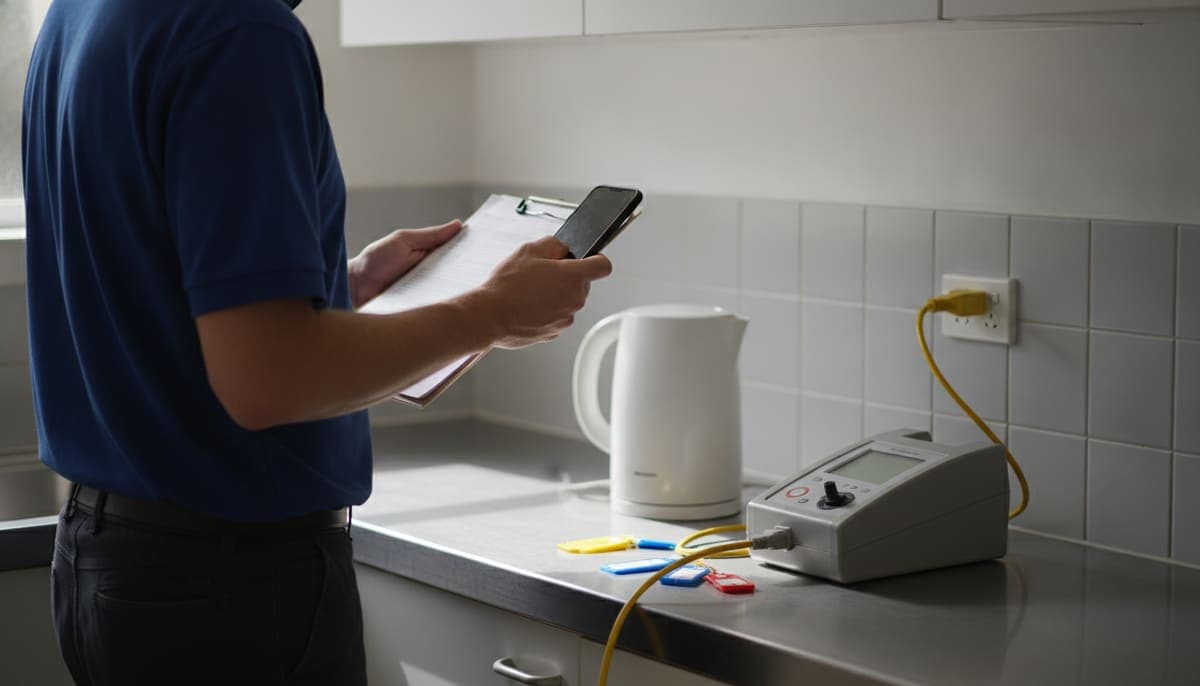
How much to charge for test and tag comes down to three numbers: a per-item rate that sits above your own cost per item, a minimum charge per visit that covers travel and set-up on small jobs, and set prices for the extras (RCDs, failed items, after-hours work) so you're not making them up on site. Published Australian rates run from roughly $2.20 to $9.50 per item, with minimums of around $100 to $250, but those figures tell you what the market charges, not what your business needs to charge.
This guide is for the operator setting prices, not for a client looking for the cheapest tester. It shows how to work out your floor, set a minimum that makes small jobs worth the drive, and write a quote that doesn't lose money. If you're still setting up, start with our guide on how to start a test and tag business, which covers training, licences, insurance and equipment.
General information only, not financial, tax or legal advice. The prices quoted here come from providers and cost-guide sites and change often. Talk to your accountant about your own costs and GST.
The four ways test and tag businesses charge
| Model | How it works | Suits | Watch out for |
|---|---|---|---|
| Per item plus a minimum | A rate per item tested, with a minimum charge per visit that often includes the first batch of items | Most commercial clients | A minimum set too low makes small jobs unprofitable |
| Call-out fee plus per item | A fixed fee for attending, then a rate for every item | Clients spread across a wide area | Clients compare your per-item rate and miss the call-out |
| Hourly or day rate | Time on site, regardless of item count | Construction, events, hire yards, jobs where the count is unknown | Clients can't predict the bill, so they push back |
| Fixed price per site or per year | One agreed price for a known site, often on a retest schedule | Repeat clients with stable equipment lists | Equipment counts creep up, so set an item limit |
Per item with a minimum is the most common model you'll see in published price lists. For example, one Queensland provider advertises a $125 + GST minimum that covers the first 32 items, a tag for each, a report and certificate, and the call-out, then $2.20 to $3.90 + GST per item after that (The Local Guys, 2026 QLD price list). That's a franchise network's own marketing, so treat it as one data point.
What the market charges
Two kinds of sources publish test and tag prices. Neither is neutral, so look at them together:
- Provider price guides. The same provider's Queensland page lists a general market range of about $2.50 to $9.50 per item and $2.50 to $9.50 per RCD, both plus GST (The Local Guys).
- Cost-guide sites. What's The Damage, an Australian cost-guide site, puts test and tag at $2.50 to $9.50 per item with a typical figure of $5, and call-outs at $150 to $250. It says its figures are national averages that include GST and were last reviewed in October 2026 (What's The Damage).
Notice that one source quotes ex GST and the other inc GST. When you compare yourself to a competitor's price, check which one you're looking at.
Large sites with hundreds of items tend to pay the low end of the range, and small offices pay the high end. That's not generosity: on a big site your travel and set-up are spread across far more items.
Step 1: Work out your cost per hour on the tools
Start with your own numbers, not a competitor's price list.
- Add up a year of running costs. Insurance, any licence fees, vehicle and fuel, phone, software, tags and printer labels, tester calibration, accounting, and the cost of your tester spread over the years you expect to use it.
- Add what you need to pay yourself for the year. As a sole trader, that has to cover your super, leave and sick days too, because nobody else is paying them.
- Estimate your testing hours. Not hours in the week: hours actually testing on client sites. Take out driving, quoting, rebooking calls, invoicing and the days with no work booked.
- Divide costs plus pay by testing hours. That's your cost per hour on the tools.
Step 2: Turn it into a per-item floor
Your per-item floor is your cost per hour divided by the items you test in an hour. The only reliable figure for items per hour is your own, so time your first few jobs from arriving to leaving. Item counts per hour vary a lot: a tidy office of desktop computers is very different from a workshop full of power tools and extension leads, or a childcare centre where every kettle is behind a locked gate.
Worked example (illustrative numbers only, not industry figures). Suppose your running costs are $25,000 a year and you want to pay yourself $75,000, so you need $100,000. You expect about 1,000 hours of actual testing in the year. Your cost per hour on the tools is $100. If you average 20 items an hour on site, your break-even is $5 per item. Add a margin for slow sites, bad debts and growth, and your rate might be $6 per item.
If that number lands well above the local market, don't just cut it. Look at the inputs: are you counting realistic testing hours, and can you raise your items per hour with better routes, a printer that tags faster, or less retyping at night?
Step 3: Set a minimum charge that covers the drive
The minimum charge exists because small jobs cost almost as much to attend as big ones. Using the example above:
- 30 minutes driving each way: 1 hour
- 15 minutes to find the contact, set up and pack down
- 30 items at 20 an hour: 1.5 hours
That's 2.75 hours, or $275 at $100 an hour. At $6 per item, the 30 items earn $180. Without a minimum, that job loses $95.
You have three ways to fix it, and most operators use a mix:
- Set a minimum that covers a typical small visit in your area.
- Charge a call-out fee for sites outside your normal area.
- Group small clients by suburb so one trip covers three small jobs. This is where good retest scheduling earns its keep.
Say what the minimum includes (for example, "includes the first 30 items, tags and certificate") so it reads as value, not a penalty.
Step 4: Price the extras before you're on site
Decide these once, write them on your price list, and you won't be negotiating in a client's kitchen:
- RCD testing. Portable RCDs and switchboard RCDs take different time and gear. Price per RCD, and say whether a push-button test or an instrument trip-time test is included.
- Failed items. You did the work, so most operators charge for the test whether the item passes or fails. Say so on the quote.
- Leads, powerboards and three-phase equipment. Leads are quick; three-phase equipment can need different adaptors and more time. Some operators price them separately.
- After-hours and weekend work. Offices often want testing done when staff are out. Use a loading, not your normal rate.
- Return visits. If equipment wasn't available on the day, decide whether a return trip is a new minimum charge.
- Repairs. Replacing a plug or fixing a lead is electrical work for a licensed electrician. Don't price it into a test and tag quote unless you hold the right licence.
Step 5: Volume pricing and repeat clients
Discounts for large sites are normal, because your cost per item really does drop. A simple tiered price (for example, one rate up to 200 items and a lower rate above that) is easier to quote than a custom deal for every client.
Two rules keep discounts from eating your margin:
- Never price below your per-item floor, even for a big client. Big sites with thin margins tie up the days you could spend on profitable work.
- Discount for commitment, not just size. A client who books their retest a year ahead, pays on the day and has equipment ready is cheaper to serve. That's worth a better rate.
How often a client needs retesting changes what they're worth to you. A construction site on a three-monthly cycle is four visits a year; an office on a longer cycle may be one. Our test and tag frequency guide covers the intervals.
How to quote a test and tag job
Ask before you price:
- How many items, roughly, and what kind (office, kitchen, workshop, construction)?
- How many sites, and are they close together?
- Are there RCDs to test, and where are they?
- When can you get access, and will equipment be unplugged and ready?
- Do they have an existing register from a previous tester you can import?
Then decide whether you're giving an estimate or a quote. The Queensland Government's business guide explains that an estimate is a rough guide that doesn't bind you, while a quote the customer accepts becomes part of a legally binding contract. It recommends a quote date, number and expiry date, a line-item breakdown with GST shown separately, payment terms and an acceptance section (Business Queensland).
When the item count is a guess, quote the rates (minimum, per item, per RCD) and give an estimated total. Don't quote a fixed total for an unknown count.
GST on your prices
If you're registered for GST, or required to be, your test and tag services are generally taxable sales and you include GST in the price (ATO). If you're not registered, you don't add GST. Either way, make it obvious whether a price is ex GST or inc GST.
If you are registered and a client asks for a tax invoice, you must provide one within 28 days unless the sale is $82.50 (including GST) or less (ATO). Most business clients will want one, so make every invoice a valid tax invoice from the start.
Review your prices every year
Your costs go up every year: insurance, fuel, calibration, tags. If your prices don't, your margin shrinks without you deciding it should. Pick a month, recheck your cost per hour and items per hour, and update your price list. Tell repeat clients before their next visit, not on the invoice.
Make sure you actually get paid
A good price is worth nothing until it's in the bank. Invoice before you leave the site, keep terms short for small clients, and send the certificate with the invoice so the client can see what they paid for.
That's the part Koalaris is built for. Visits and invoices come from the same job you just tested, clients can pay by card on their phone through a QR code straight into your own Stripe account, and invoices sync to Xero. The Solo plan is $29 a month with unlimited clients and sites, and there's a 14-day free trial with no card needed.
Frequently asked questions
How much should I charge per item for test and tag?
Published Australian rates run from roughly $2.20 to $9.50 per item, depending on the source and whether GST is included. Your rate should start from your own cost per testing hour divided by the items you test in an hour, plus a margin. Large sites usually pay less per item than small offices.
Should I charge a call-out fee or a minimum charge?
Most operators use one or the other, because small jobs cost nearly as much to attend as big ones. A minimum that includes a set number of items is easy for clients to understand. A call-out fee suits sites outside your normal area.
Should I charge for items that fail?
Most operators do, because the inspection and test took the same time whether the item passed or not. Put it on your quote so it isn't a surprise. Repairing the item is separate electrical work for a licensed electrician.
Is it better to charge per hour or per item?
Per item is easier for clients to compare and budget for, and it rewards you for working efficiently. Hourly or day rates suit jobs where the item count is unknown, such as construction sites or events.
Do I have to charge GST on test and tag?
Only if you're registered for GST or required to be. Registration is compulsory once your GST turnover reaches $75,000 a year (ATO). Ask your accountant whether registering earlier suits your clients.

Mohammed spent seven years in equipment maintenance, electrical safety testing and medical equipment servicing before building Koalaris. He holds a Test & Tag qualification and a Queensland Restricted Electrical Licence.
Keep reading
 Compliance
Test and tag requirements in NSW: what the WHS Regulation says
When test and tag is legally required in NSW, what clause 150 covers, RCD rules, who can test and what a test record must show under the WHS Regulation 2025.
 Compliance
Test and tag requirements in Queensland: what the 2026 Regulation says
Who must test and tag in QLD, legal maximum intervals by type of work, what a tag must show, and licence rules under the Electrical Safety Regulation 2026.
 Guides
How to choose test and tag software: a buyer's checklist
A practical checklist for choosing test and tag software in Australia: offline use, records, imports, tags, invoicing, client access, exports and total cost.
See your register the way Lyra sees it.
Start a 14-day free trial of Pro. No card needed.