Test and tag certificates: what to include for your clients
What a test and tag certificate should show, what the WHS laws actually require, the wording to use, and how to hand certificates to clients after each visit.
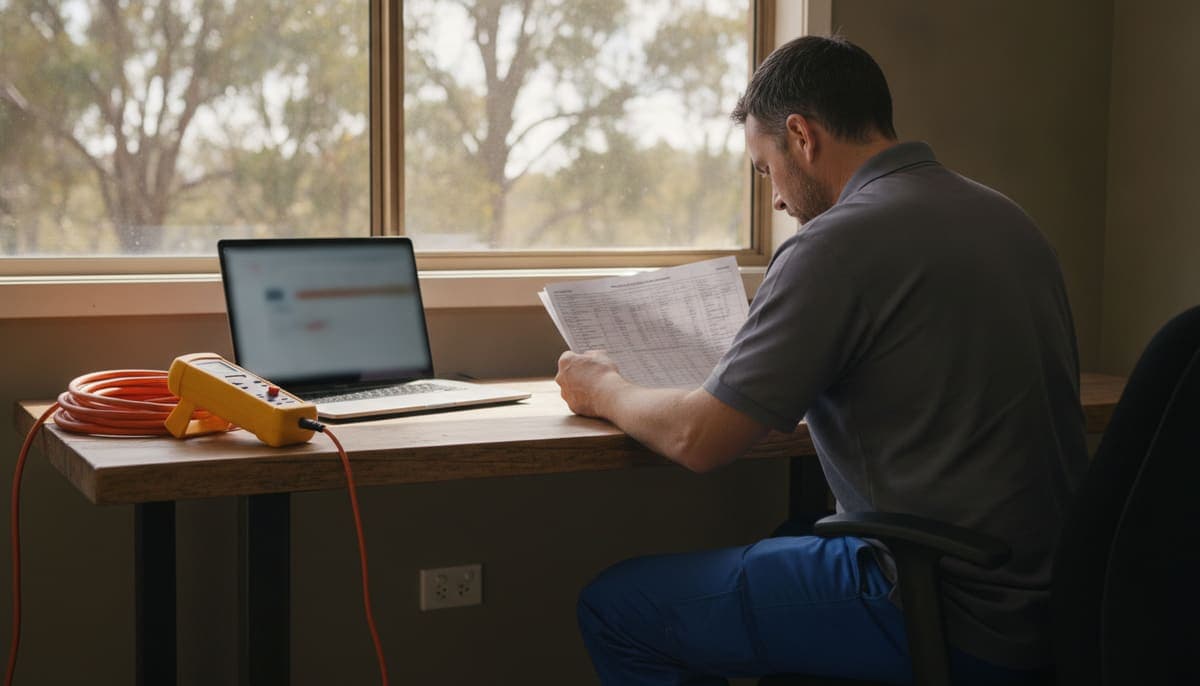
A test and tag certificate is the document you hand a client after a visit to show what was tested, by whom, when, the result for each item and when each item is next due. The WHS laws don't ask for a document called a "certificate". They ask for a record of testing with four details. A good certificate covers those four details for every item, adds what your client needs to prove compliance to an auditor or insurer, and is easy to read.
This guide is for test and tag operators. It separates what the law requires from what clients and auditors expect, lists what to put on the certificate, covers the wording to use and the mistakes to avoid, and explains how to deliver it.
General information only, not legal advice. Check the current WHS or electrical safety regulation where you work, AS/NZS 3760 and any client or contract requirements.
What the law requires, and where a certificate fits
In the states and territories that use the model WHS Regulations, a record of testing electrical equipment must specify (SafeWork SA):
- the name of the person who carried out the testing
- the date of the testing
- the outcome of the testing
- the date the next test is due
That record can be the tag on the equipment, or a logbook, register or computerised database. It must be kept until the next test, or until the item is permanently removed from the workplace or disposed of. SafeWork SA lists an expiation fee of $144 for an individual and $720 for a body corporate for breaching the record rule.
So the tag can meet the legal minimum on its own. The certificate is what turns a day of tags into one document the client can file, show an auditor and compare with next year's visit. Queensland and Victoria handle records differently, and construction sites carry heavier record keeping. Our guide to what test and tag records the law requires covers those differences and how long to keep each record.
What to include on a test and tag certificate
The list below combines the legal details with what clients, auditors and head contractors commonly ask for. Only the four legal details are mandatory in model WHS states. The rest is good practice.
The header
- Your business details. Business name, ABN, phone and email, and your logo. If your state requires a licence for the work you do, include the number.
- A certificate number. A unique reference makes it easy to find the right document when a client calls about "last year's test".
- Who it's issued to. The client's business name, the site name and the site address. One certificate per site is easier to file than one per client.
- The date or dates of testing. Use the actual test dates, not the date you produced the document.
- The technician or technicians. The name of each person who did the testing. This is one of the legal details.
- The standard. State which standard the work was done to, such as AS/NZS 3760:2022, or AS/NZS 3012 on construction and demolition sites.
The item list
For each item tested:
- the asset ID, matching the number on the tag
- a description (for example, "kettle 1.7 L" rather than "kettle")
- the location (building, floor or room)
- the equipment class or type: Class I, Class II, cord set, RCD and so on
- the result: pass or fail
- the next due date
Many operators also include the readings (earth continuity, insulation resistance or leakage current) or attach them as a separate schedule. Clients rarely read them, but auditors sometimes ask, and they're useful when a result is close to the limit.
If you inspected but didn't test an item, or couldn't reach an item that's on the client's register, say so on the certificate. A list that only shows what passed hides the gaps the client needs to know about.
The summary and failures
- Totals. Items tested, passed and failed.
- Failed items. What was found, what you did (tagged out of service, withdrawn from use, handed to the client) and what the client needs to do next: repair, replace or dispose of it.
- RCDs. If you tested RCDs, list them separately with the type of test (push-button or operating time) and the result. Push-button and instrument tests check different things, so record which one you did.
The statement and sign-off
A short statement of what was done, such as: "The equipment listed was inspected and tested in accordance with AS/NZS 3760:2022. Items recorded as a pass were tagged and returned to service. Items recorded as a fail were withdrawn from service at the time of testing."
Finish with the name of the person who did the testing and, if you use one, a signature.
Wording to use, and wording to avoid
The certificate is a record of what you found on the day. Write it that way.
- Describe the work, not a guarantee. "Inspected and tested in accordance with AS/NZS 3760:2022" says what you did. Saying an item is "safe" or "compliant until" the next due date promises something no test can: equipment can be damaged the day after you leave.
- Don't call it an electrical safety certificate. Licensed electricians issue statutory certificates for electrical installation work, such as a Certificate of Compliance for Electrical Work (CCEW) in NSW or a Certificate of Electrical Safety in Victoria. A test and tag certificate is a different document, so give it a different name: "certificate of test" or "test and tag report" both work.
- Set retest dates from the risk, not a default. Each next due date should match the environment the item is used in. The test and tag frequency guide sets out the usual intervals.
Common certificate mistakes
- Asset IDs that don't match the tags. If the tag says 0412 and the certificate says "kettle, kitchen", nobody can prove which kettle was tested.
- Failures left off. An item that failed is part of the test record. Leaving it off makes the certificate look cleaner and the client less safe.
- One certificate for many sites. Auditors at one site don't want to read through another site's equipment.
- Typing it up again later. Re-entering results from a clipboard or spreadsheet is where wrong dates and missing items come from. Produce the certificate from the same record you tested into.
- A week's delay. Clients often need the certificate for an audit or a tender. Sending it on the day, with the invoice, shows what they paid for.
How to deliver certificates to clients
Most operators email a PDF after each visit. Some clients, such as schools, builders and property managers, will also want the register behind it, so agree in your quote what you hand over after each visit: a certificate, a full register or both, and in what format.
Keep your own copy. The legal duty to keep records sits with your client, but when a question comes up two years later, it's easier to answer from your own system than to ask the client to find an email attachment.
A client portal goes one step further. Instead of searching their inbox, the client logs in and sees their register, test history and every certificate. It also cuts the "can you resend last year's report?" emails.
Certificates in Koalaris
In Koalaris, the certificate is built from the results you record in the field app, so nothing is typed twice. Certificates are PDFs with your business details and logo, and they list each item with its location, class, result and next due date, with failures and totals in a summary. Your clients see their register, history and certificates in a free client portal (here's what your clients see). See the certificates and reports features for the rest.
Every business can start on the Free plan, with no card and no end date. Free certificates carry your logo and a small "Made with Koalaris" line. The Solo plan, at $29 a month, shows your branding only and adds invoicing from the finished visit.
Frequently asked questions
Is a test and tag certificate a legal requirement?
Not as a document with that name. In model WHS states, the law requires a record showing who tested the item, the date, the outcome and the next due date, and a tag can be that record. A certificate is the usual way to give the client that record for a whole site in one place.
What's the difference between a test tag and a certificate?
The tag is attached to one item and shows the details for that item. The certificate lists every item tested at a site on one document, with totals, failures and what the client should do next. Tags get damaged or removed, so the certificate also backs them up.
Who should keep the test and tag certificate?
The client, because the legal duty to keep records sits with the business that has the equipment. As the provider, keep your own copy too.
How long is a test and tag certificate valid?
A certificate doesn't expire as a whole. Each item has its own next due date, set by the environment it's used in. The certificate is a record of the result on the test date, not a promise that the equipment stays safe until then.
Should failed items be on the certificate?
Yes. A failure is a test result like any other. Show the fault, what you did with the item and what the client needs to do next.
Is a test and tag certificate the same as a certificate of currency?
No. A certificate of currency is from your insurer and shows that your insurance policy is current. Clients often ask for one before you start work. A test and tag certificate records the results of the testing.

Mohammed spent seven years in equipment maintenance, electrical safety testing and medical equipment servicing before building Koalaris. He holds a Test & Tag qualification and a Queensland Restricted Electrical Licence.
Keep reading
 Guides
Test and tag on construction sites: AS/NZS 3012 requirements
Construction site test and tag requirements under AS/NZS 3012: 3-monthly retests, RCD checks, site tags, records, and how operators quote and run site work.
 Guides
RCD testing frequency: push-button and trip-time tests explained
How often to test RCDs (safety switches) at work in Australia: push-button vs trip-time tests, regulator timeframes, construction sites and the records to keep.
 How-to
Looking for a WinPATS alternative? How to export your test and tag records
Leaving WinPATS? How to export your records from WinPATS for Windows or the WinPATS app to CSV, split them by site and import them into a new register.
See your register the way Lyra sees it.
Start free, for as long as you like. No card needed.