Getting paid on the day: invoicing for test and tag businesses
What a test and tag invoice must show, how to lay out per-item lines, payment terms that work, card payments on site after the 2026 surcharge ban, and chasing.
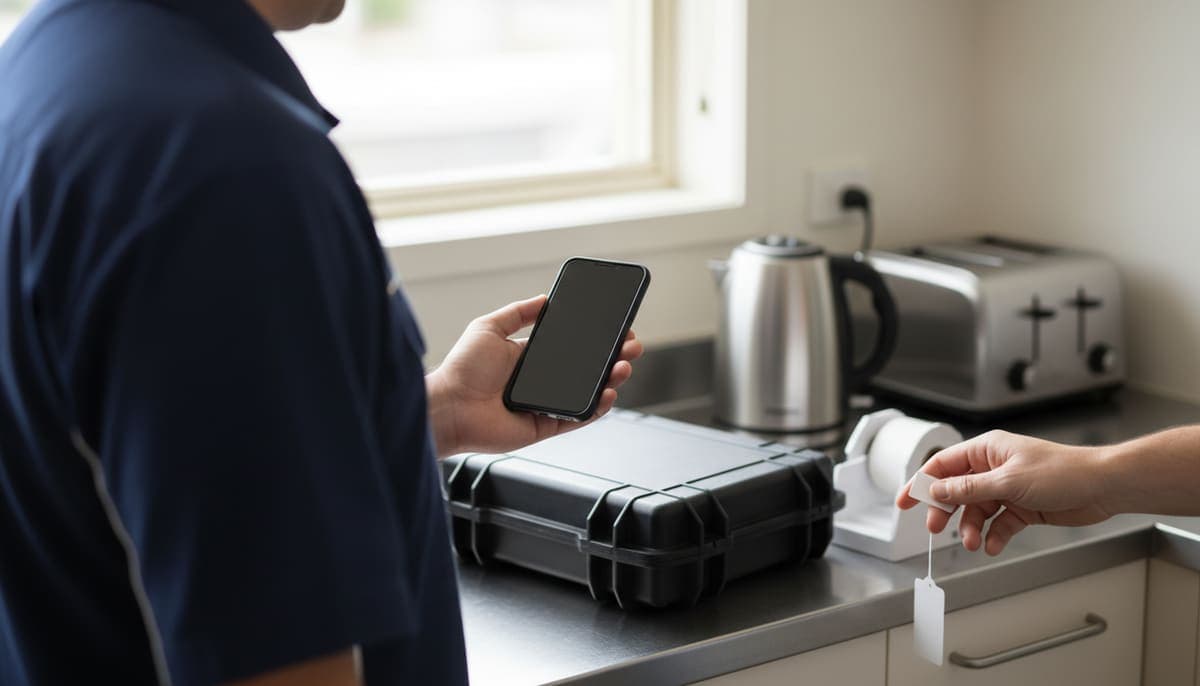
A good test and tag invoice does three jobs. It meets the ATO rules, it shows the client exactly what they're paying for, and it makes paying you the easiest thing they'll do all day. In practice that means:
- a valid tax invoice (or a plain invoice if you're not registered for GST)
- line items that match the visit: call-out or minimum, items tested, RCDs and any extras
- a clear due date and payment options
- sending it before you leave the site, with the certificate
This guide covers what has to be on the invoice, how to lay out the lines, which payment terms suit test and tag work, how card payments changed in October 2026, and what to do when an invoice goes overdue.
General information only, not tax or legal advice. Check the current ATO guidance and talk to your accountant about your own situation.
What a test and tag invoice must include
The legal requirements depend on whether you're registered for GST.
If you're registered for GST: a tax invoice
If a client asks for a tax invoice, you must give them one within 28 days, unless the sale is $82.50 (including GST) or less (ATO). Almost every business client will ask, because they need it to claim the GST back. So make every invoice a valid tax invoice from the start.
For sales under $1,000, the ATO says a tax invoice must include enough information to clearly work out:
- that the document is intended to be a tax invoice
- your identity
- your ABN
- the date it was issued
- a brief description of what you sold, with the quantity and price
- the GST amount, shown separately or as "Total price includes GST" if it's exactly one-eleventh of the total
- how much of each sale is taxable
For sales of $1,000 or more, the invoice also needs the buyer's identity or ABN. You can use the $1,000-or-more format for every invoice, which is simpler than switching. A bigger site, a school or a multi-site client can pass $1,000 in one visit.
If you're not registered for GST: a regular invoice
Below the $75,000 GST turnover threshold, registration is optional (our guide to starting a test and tag business covers that choice). If you're not registered, your invoice must not say "tax invoice" and shouldn't show any GST. There's no law that sets out what a regular invoice must contain, but business.gov.au lists common practice (business.gov.au):
- the word "invoice"
- your business name and ABN
- a unique invoice number and the date
- your contact details
- a description with quantity and price
- when and how to pay
- the buyer's name or business name
Always put your ABN on the invoice. If a business pays a supplier who hasn't quoted an ABN, it generally has to withhold 47% of the payment and send it to the ATO, unless an exception applies (ATO). Expect a client's accounts team to ask for it before they pay.
What to add for a test and tag job
The law sets the minimum. These extras save you phone calls:
- The site address and visit date, so a client with several sites can match the invoice to the job.
- The client's purchase order or reference number, if they gave you one. Many larger clients won't pay an invoice without it.
- A link or reference to the certificate for that visit.
- Payment details: bank account, a card payment option, and the due date as an actual date.
How to lay out the line items
Clients query invoices they can't follow. If your invoice says "Test and tag: $486", the client's accounts team has to email you to ask what that covers. Break it down the same way you priced it (our guide on how to price test and tag work covers the price side):
| Line | Example description | Why it's a separate line |
|---|---|---|
| Call-out or minimum charge | Call-out, Level 2 office, 14 Smith St | Shows the fixed cost of the visit |
| Items tested | Test and tag, 112 items @ per-item rate | The quantity should match the certificate |
| RCD tests | RCD trip-time tests, 6 RCDs | Often priced separately |
| Leads and powerboards | Extension leads and powerboards, 18 | Only if you price them differently |
| Failed items | Items failed and tagged out, 3 | Shows the client which items need action |
| Replacement parts or tags | Replacement plug tops, 2 | Only if you supplied something |
| Discount | Repeat client discount | Better shown than hidden in the rates |
The quantity on the invoice should match the count on the certificate. When the two agree, the client can check one against the other in a minute and pay. When they don't, they'll ask why.
Pick ex GST or inc GST and use it everywhere: your quote, your price list and the invoice. A client comparing a quote "from $4 an item" with an invoice at $4.40 an item will think you've raised the price.
Invoice on the day, not on Friday night
Test and tag invoices are usually small and the work is finished in one visit, so there's no reason to wait. business.gov.au suggests sending the invoice at the time of the sale to encourage the customer to pay on time. A visit you invoice on site:
- is fresh in the client's mind, with the tags still on the equipment they're looking at
- can be paid before you leave, especially by a small business owner who's standing right there
- doesn't become one of 20 invoices you're writing up at the weekend
The habit that makes this work is producing the invoice from the test results, not typing it again. If you count the items on the certificate and then type the number into a separate invoice app, you'll eventually invoice 112 items when you tested 121.
Send the certificate with it
The certificate is the proof of what the client is paying for. Send it with the invoice or in the same email. Clients often need it for an audit, a tender or an insurer, and a client who has the certificate in hand is less likely to sit on the invoice. Our guide to test and tag certificates covers what to put on them.
Payment terms that suit test and tag work
You set your own payment terms, so put them on your quote and your invoice. Some practical rules:
- Small clients: due on the day or within 7 days. Cafés, small offices and clubs can usually pay on the spot by card.
- Larger clients: agree the terms when you quote. Schools, councils, builders and property managers often have their own payment runs and won't change them for you. Find out before the job, not after.
- Use a date, not "14 days". "Due 14 November 2026" leaves less room for argument than "14 days".
- Ask for the PO number when you book. A missing PO is one of the commonest reasons a larger client's invoice sits unpaid.
- Late fees only if agreed. If you plan to charge interest or a late fee, put it in your quote or terms before the work. business.gov.au's letter of demand checklist says to include a late payment interest rate only if it was specified in the contract.
Taking card payments on site
The fastest way to get paid is for the client to pay before you leave. You have a few options:
- Bank transfer. Cheap, but the client has to log into their bank, and many small business owners leave it for later.
- A card reader. Works, but it's another device to buy, charge and carry.
- A payment link or QR code. The client opens it on their own phone and pays by card. Nothing extra to carry.
No more card surcharges from 1 October 2026
If you used to add a card surcharge, stop. Following the Reserve Bank's reforms (Reserve Bank of Australia), businesses can no longer surcharge payments made with Visa, Mastercard, American Express or eftpos credit, debit or prepaid cards from 1 October 2026 (ACCC). The ACCC suggests checking the card network rules or asking your payment provider how the rules apply to you.
For a test and tag business, the practical answer is to build your card fees into your rates, the same way you build in tags and fuel. Your per-item rate and minimum charge should cover what it costs to be paid.
Chasing overdue invoices without losing the client
Most late payments are disorganisation, not refusal. A calm, step-by-step process gets most of them paid:
- Make it easy first. Check the invoice reached the right person and had the PO number and certificate attached.
- Send a friendly reminder a day or two after the due date, with the invoice and a payment link attached again.
- Call. A two-minute phone call to the person who booked you often finds the problem: wrong email address, missing PO, or someone on leave.
- Send a second, firmer reminder with a clear new date.
- Send a letter of demand if it's still unpaid. business.gov.au explains what to include and has a template (business.gov.au). It warns that a letter of demand can inflame a dispute, so use it once the friendly steps have failed.
For repeat clients, keep in mind what they're worth: a client you test every year is a recurring booking. Firm and polite usually keeps both the money and the client.
Common invoicing mistakes in test and tag
- A total with no breakdown. It invites a query and delays payment.
- Item counts that don't match the certificate. The client notices, and so will an auditor.
- No ABN, or "tax invoice" when you aren't registered. Both are easy to avoid.
- Invoicing weeks later. The longer the gap after the visit, the slower the payment.
- Mixing ex GST and inc GST across your quote and invoice.
- No way to pay on the spot for a small client who would have paid there and then.
- No system for overdue invoices. If you can't see at a glance who owes you what, you'll chase the wrong people.
Invoicing in Koalaris
We built Koalaris invoicing for exactly this. Invoices start from the visit you just finished, with lines from your price list (call-out and per-item rates), so you never retype a job. You check the draft, issue it and email it as a branded PDF. Clients can pay by card on their own phone through a QR code, straight into your own Stripe account. You can see what's overdue at a glance and send a reminder in one click, and issued invoices and card payments sync to Xero.
Invoicing is on the Solo plan at $29 a month. You can start on the Free plan with no card and no end date, then upgrade when you want to invoice from the app.
Frequently asked questions
Do I need to give a tax invoice for a test and tag job?
If you're registered for GST and your client asks for one, yes: you must provide it within 28 days, unless the sale is $82.50 including GST or less. Most business clients will want one to claim their GST credits, so it's simplest to make every invoice a valid tax invoice.
What should I write on an invoice if I'm not registered for GST?
Call it an "invoice", not a "tax invoice", and don't show any GST. Include your business name, ABN, an invoice number, the date, a description with quantities and prices, and how and when to pay.
Can I charge a card surcharge on test and tag invoices?
No. From 1 October 2026, businesses can no longer surcharge payments made with Visa, Mastercard, American Express or eftpos credit, debit or prepaid cards. Build your card costs into your prices instead, and check with your payment provider if you're unsure how the rules apply to you.
Should the invoice list every item I tested?
Usually not line by line. Show the quantity and rate on the invoice, and list every item with its result on the certificate or test report. The counts on the two should match.
How quickly should I send a test and tag invoice?
On the day, ideally before you leave the site. Small clients can often pay on the spot, and an invoice sent with the certificate while the visit is fresh tends to be paid faster than one that arrives weeks later.

Koalaris is test and tag software built in Australia. See what it does.
Keep reading
 Compliance
Test and tag requirements in WA: what the WHS laws say
Is test and tag mandatory in WA? What the WHS (General) Regulations 2022 require, WorkSafe WA's suggested intervals, who can test, RCDs and records to keep.
 How-to
Metrel ES Manager export: getting your test and tag records into a cloud register
How to export test and tag records from Metrel ES Manager to Excel, what the Basic and Pro exports contain, and how to bring them into a cloud register.
 Guides
Test and tag on construction sites: AS/NZS 3012 requirements
Construction site test and tag requirements under AS/NZS 3012: 3-monthly retests, RCD checks, site tags, records, and how operators quote and run site work.
See your register the way Lyra sees it.
Start free, for as long as you like. No card needed.