Failed test and tag items: what to do when equipment fails
What to do when an item fails test and tag: tag it out, withdraw it, tell the client, arrange repair or disposal, retest before reuse and keep the record.
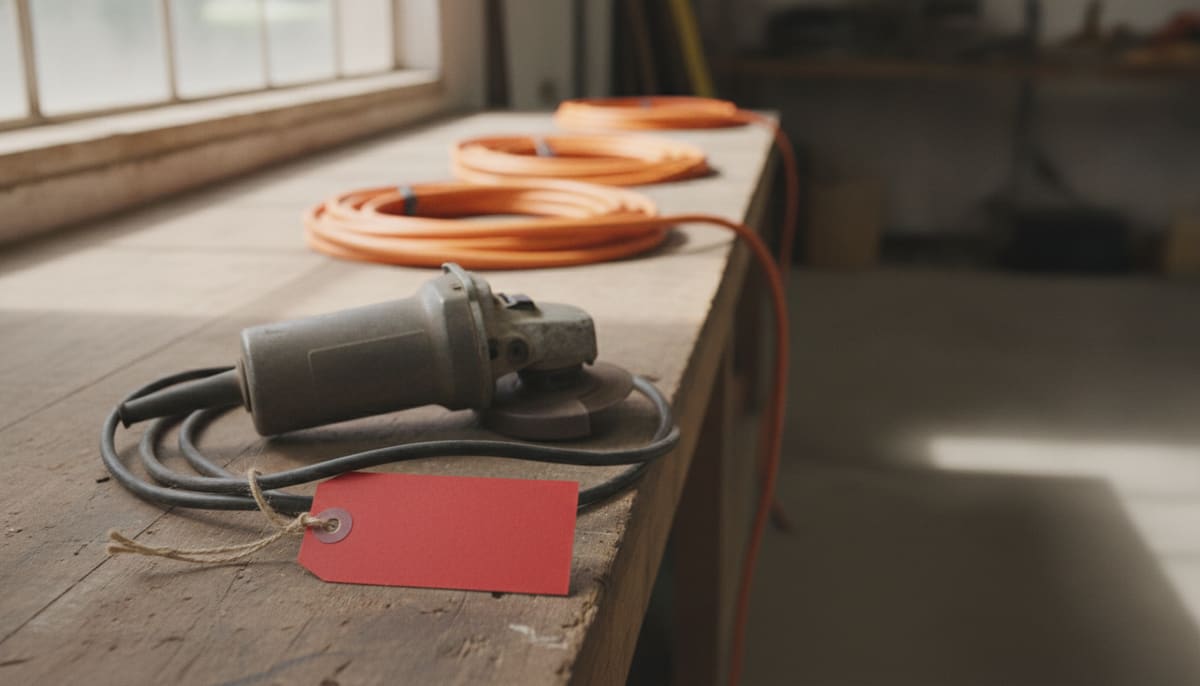
When an item fails test and tag, what you do next is the same everywhere: tag it out of service on the spot, make sure it's withdrawn from use, tell the client what failed and why, and record the failure. After that, the item has three possible futures. It's repaired by someone licensed to repair it and tested again before anyone uses it, or it's replaced, or it's thrown away. Until one of those happens, it stays out of service.
This guide is for test and tag operators. It covers the steps on the day, who's responsible for what afterwards, when a repaired item needs retesting, and what to keep in the record so a failure doesn't fall through the cracks.
General information only, not legal advice. Requirements differ by state, territory and industry. Check your regulator, the current edition of AS/NZS 3760 and any site or contract rules before you rely on this.
What the law says about failed equipment
The rules are short, and they're mostly about the business that owns or controls the equipment, not the tester.
- Model WHS states (NSW, WA, SA, Tasmania, the ACT, the NT). The WHS Regulations require the business with management or control of electrical equipment to make sure unsafe equipment is disconnected or isolated from its supply and isn't reconnected until it's repaired or tested and found to be safe, or is replaced or permanently removed from use. The code of practice adds that unsafe equipment should be labelled to show it's unsafe and must not be used, so nobody uses it by accident before it's tested, repaired or replaced (Managing electrical risks in the workplace code of practice).
- Queensland. The Electrical Safety Regulation 2026 has its own unsafe-equipment rule with the same disconnect-until-repaired-or-replaced test. For equipment that must be tested, it goes further: if the competent person decides an item isn't safe to use, they must immediately attach a durable tag warning people not to use it, and the item must be immediately withdrawn from use.
- Construction sites. Site rules follow AS/NZS 3012. WorkSafe Victoria's construction industry standard, for example, says faulty items must be withdrawn from service and tagged as faulty, and that repairs must be done by an authorised repair agent, service personnel or a licensed electrician, with the item retested before it goes back into use.
Victoria isn't a model WHS state, but WorkSafe Victoria's general guidance lands in the same place: damaged equipment should be tagged out and either repaired by a competent person or discarded (WorkSafe Victoria).
So the legal duty to keep a failed item out of use sits with your client. Your job is to identify it, tag it, tell them and record it, in a way that makes it easy for them to meet that duty.
On the day: five steps for every failed item
1. Tag it out straight away
Fit an out-of-service tag before you move to the next item. In its section on out-of-service tags, the code of practice says a tag should be durable, securely attached, and clearly state the defect or the reason the equipment is unsafe. Write the reason on it ("cracked plug", "failed insulation resistance"), plus your name or company and the date. Our guide to what a test tag must show covers the wording and how fail tags differ from coloured pass tags.
2. Get it out of use
A tag on an item that's still plugged in at a desk isn't much protection. Unplug it and hand it to the site contact, or put it wherever the client keeps quarantined gear. Agree that spot before the visit starts so failed items don't end up back on a shelf.
On a construction site, tell the supervisor before you leave and give them a list of what came out of service. A missing drill matters to the crew who were about to use it.
3. Tell the client what failed and why
Clients act on failures they understand. For each item, give them:
- the item and its asset number
- where it was (site and location)
- what failed: visual inspection, earth continuity, insulation resistance, leakage current or RCD trip time
- a plain description of the fault, such as "outer sheath cut, inner cores visible"
- what they need to decide: repair, replace or dispose of it
Put the same list on the certificate or service report for the visit. Our guide to test and tag records explains why failures belong in the record, not only on the tag.
4. Don't repair it unless you're licensed to
Replacing a plug or a damaged cord is electrical work in most cases. WorkSafe Queensland, for example, notes that a restricted contractor licence endorsed only for testing and tagging doesn't allow repairs (WorkSafe Queensland). If you hold an electrical licence that covers the repair, you can offer it as a separate service. If you don't, refer the client to an electrician or the manufacturer's authorised repairer.
5. Record the failure
Record the result as a fail with the readings, the reason, the date and who tested it. Keep the record even if the client throws the item away the same afternoon. A history of failures is what shows a client which sites are hard on equipment, and it's what an inspector or insurer asks for after an incident.
After the visit: repair, replace or dispose
The decision is the client's. It usually comes down to what the item is worth, what's wrong with it and whether it's safe to repair.
| Outcome | When it makes sense | What has to happen before reuse |
|---|---|---|
| Repair | Valuable equipment with a fixable fault, such as a damaged plug or lead on a power tool | Repaired by someone licensed or authorised to repair it, then inspected and tested before it goes back into service |
| Replace | Cheap items (kettles, powerboards, phone chargers) or items with damaged casings | Brand-new equipment doesn't need a test before first use, but it should be visually inspected and added to the register |
| Dispose | Unsafe to repair, not worth repairing, or no longer needed | Permanently removed from use and marked as disposed in the register |
A few notes on each:
- Repair. The code of practice says equipment should also be tested after a repair or service that could affect its electrical safety, by the person who did the repair, before it goes back into service. Many clients prefer to have you retest it anyway, so offer a retest visit or test it at the next scheduled round, and keep the tag out until then if the repairer hasn't tested it.
- Replace. The code says brand-new equipment that has never been used doesn't have to be tested before first use, but should still be visually inspected for damage. Add it to the register so it doesn't miss its first test. Second-hand replacements should be tested before first use.
- Dispose. Make sure the item leaves the site or goes to a clearly marked disposal area. Mark it as disposed in the register rather than deleting it, so the history still shows what happened to it.
Retesting a repaired item
When a repaired item comes back to you:
- Check the repair visually: correct plug, cord anchorage secure, no exposed conductors.
- Run the full set of tests for its class, as you would for any in-service test under AS/NZS 3760.
- If it passes, fit a new pass tag and record the test against the same asset number, so the history shows the fail, the repair and the pass in order.
- Set the next due date from the retest. The interval depends on the environment, not on the fact that it was repaired. Our test and tag frequency guide covers the usual intervals.
If it fails again, tag it out again and tell the client. Two fails on the same item is usually a good argument for replacing it.
Failed RCDs
RCDs are handled a little differently. Under the model WHS code, an RCD that is tested and found faulty must be taken out of service and replaced as soon as possible. In Queensland, a safety switch that isn't working properly must be tagged with a warning and withdrawn from use immediately. A fixed RCD at the switchboard is part of the electrical installation, so replacing it is work for a licensed electrician. Flag it to the client as urgent, because the circuits it protects are unprotected until it's replaced.
Common mistakes
- Leaving failed items off the certificate. It makes the paperwork look cleaner and leaves the client without the list they need.
- Tagging out but not withdrawing. If the item stays plugged in, the tag is the only control, and tags get ignored.
- No reason on the tag. "Do not use" without a reason means someone has to retest the item just to find out what's wrong.
- Losing the link after a repair. If the repaired item gets a new asset number, the history breaks and the failure looks unresolved.
- Not quoting for failures. You did the test whether it passed or not. Say on your quote how failed items are charged.
Tracking failures in Koalaris
In the Koalaris field app, you tap Pass or Fail yourself on every test, and the printed tag matches the result: you can preview pass and fail tags before a real one prints. Certificates list every item with its result and next due date, with failures and totals in a summary, so the client gets the list of what came out of service before you leave. Clients can see their register and each item's history in a free client portal, and report a faulty item from their phone. Every business starts on the Free plan, with no card and no end date. See how results, tags and certificates fit together on the Koalaris features page.
Frequently asked questions
What should I do if an item fails test and tag?
Tag it out of service immediately with the reason, make sure it's unplugged and withdrawn from use, tell the client, and record the failure. The client then has it repaired by someone licensed to repair it, replaces it or disposes of it.
Can a test and tag technician repair a failed item?
Only if they hold a licence or authorisation that covers the repair. Replacing a plug or a cord is usually electrical work. A test and tag qualification on its own lets you test and tag, not repair.
Does a repaired item need to be tested again?
Yes. The model WHS code of practice says equipment should be tested after a repair that could affect its electrical safety, before it goes back into service. On construction sites, guidance such as WorkSafe Victoria's says the item must be retested before it's used again.
Who is responsible for keeping a failed item out of use?
The business that has management or control of the equipment, which is usually your client. Your role is to identify the fault, tag it, tell them and record it clearly enough that they can act on it.
Should failed items stay in the register?
Yes. Keep the failure and what happened next: repaired and retested, replaced or disposed of. Deleting the item loses the history that shows the failure was dealt with.

Koalaris is test and tag software built in Australia. See what it does.
Keep reading
 Guides
Test and tag for events and markets: a guide for operators
Test and tag for events and markets: what organisers and councils ask stallholders for, AS/NZS 3002, leads and RCDs, and how operators run event-day testing.
 How-to
Test and tag register template (free CSV) and how to fill it in
Download a free test and tag register template in CSV. What each column means, the extra columns worth adding, and how to stop Excel breaking your tag numbers.
 Guides
Changing test and tag software without losing your history
Changing test and tag software? When to switch in the retest cycle, how to keep your tags, asset numbers and old certificates, and what to tell your clients.
See your register the way Lyra sees it.
Start free, for as long as you like. No card needed.